

Born in Gullane, Scotland in 1820 Mathew Dawson was one of seven brothers, four of which (including himself) became elite trainers in their own right. His father George Dawson was also a renowned trainer and strict disciplinarian, who taught his sons that training was a science of observation rather than just physical labour.
Gullane at the time, was a major hub for Scottish horse racing, with the sandy turf of the Lammermuir Hills proving to be the perfect training ground.
Throughout the 19th Century, the “Dawson Dynasty”, which consisted of Mathew’s other brothers, Thomas, Joseph, John collectively won everything there was to win in British horse racing, creating one of the biggest family monopolies the sport has ever seen.
After learning the trade in Scotland, Dawson moved south to England where he eventually became the private trainer of Lord Eglinton. It was here that he trained his first great horse, The Flying Dutchman, who went on to win both the Derby and St Leger in 1849.
The Newmarket Move And Continued Ascendancy
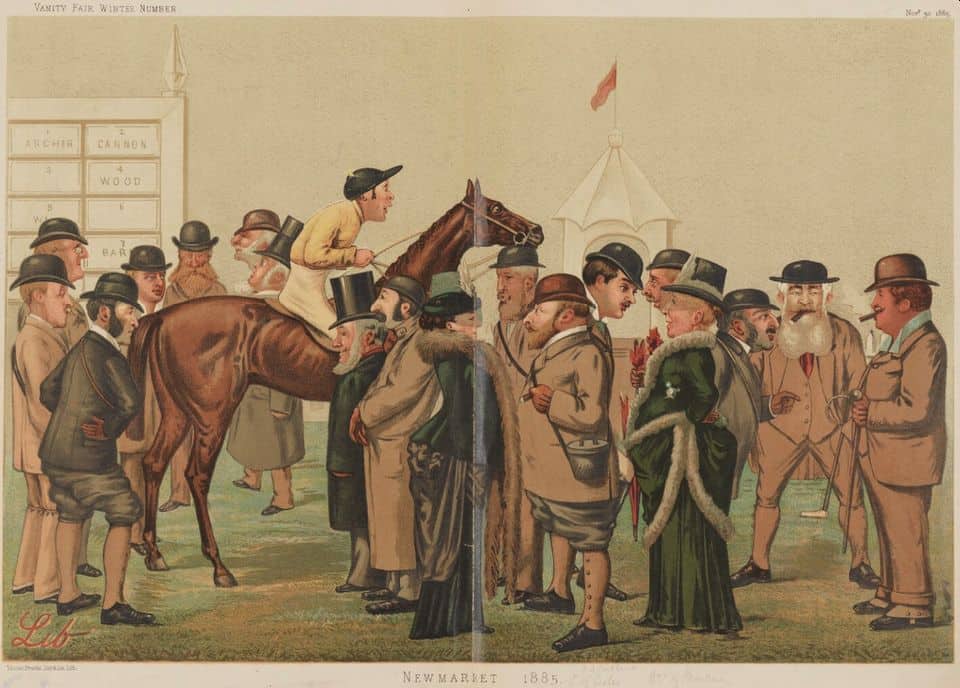
In 1866, Dawson moved to Heath House, Newmarket which was understood to be in decline at the time, with his success often credited for revitalising the town.
His most successful period came during his tenure as private trainer for Lord Falmouth. Both of them shared a strict code of ethics, with Falmouth famously never betting on his own horses, racing purely for the honour and prize money.
Together, they essentially dominated the racing calendar. During the 1870s and 1880s, the Dawson-Falmouth-Archer was considered to be unbeatable. As such, he trained the winners of a record 26 British Classics, including six Epsom Derbies.
The Discovery Of Fred Archer
Referred to above in the triumvirate, jockey Archer was taken on by Dawson as an 11-year-old apprentice at Heath House, though their relationship was often strained by intensity.
However, Dawson’s daughter, Helen eventually married Archer, which created a deep familial bond between the duo, leading to almost unparalleled success, with Dawson applying a firm but parental approach to his training methods.
Notable Champions For Dawson
During his career, Dawson discovered and trained a number of top horses. In addition to The Flying Dutchman who won “The Great Match” against Voltigeur in 1851, a race that stopped the nation, there were several others.
Silvio and Wheel Of Fortune were key to Dawson’s success as a trainer, proving to be key winners for Falmouth and cementing the former’s reputation as a master of the middle distance horse.
Both Minting and Melton were horses that proved Dawson could adapt his training style to increase the speed of a Victorian thoroughbred.
A Legacy That Lasted
Dawson was considered to be a pioneer of the theory that horses should not be subject to rigorous training and ‘over galloped’, usually preferring to bring them to the track fresh and sharp mentally, in contrast to many other trainers of the era.
Following his retirement, he was succeeded at Heath House by his assistant, James Waugh, though his influence lived on through the trainers that he mentored.
By the time of his death in 1898, Dawson was regarded as the ultimate authority on the thoroughbred; a man whose word was essentially ‘law’ on Newmarket Heath.